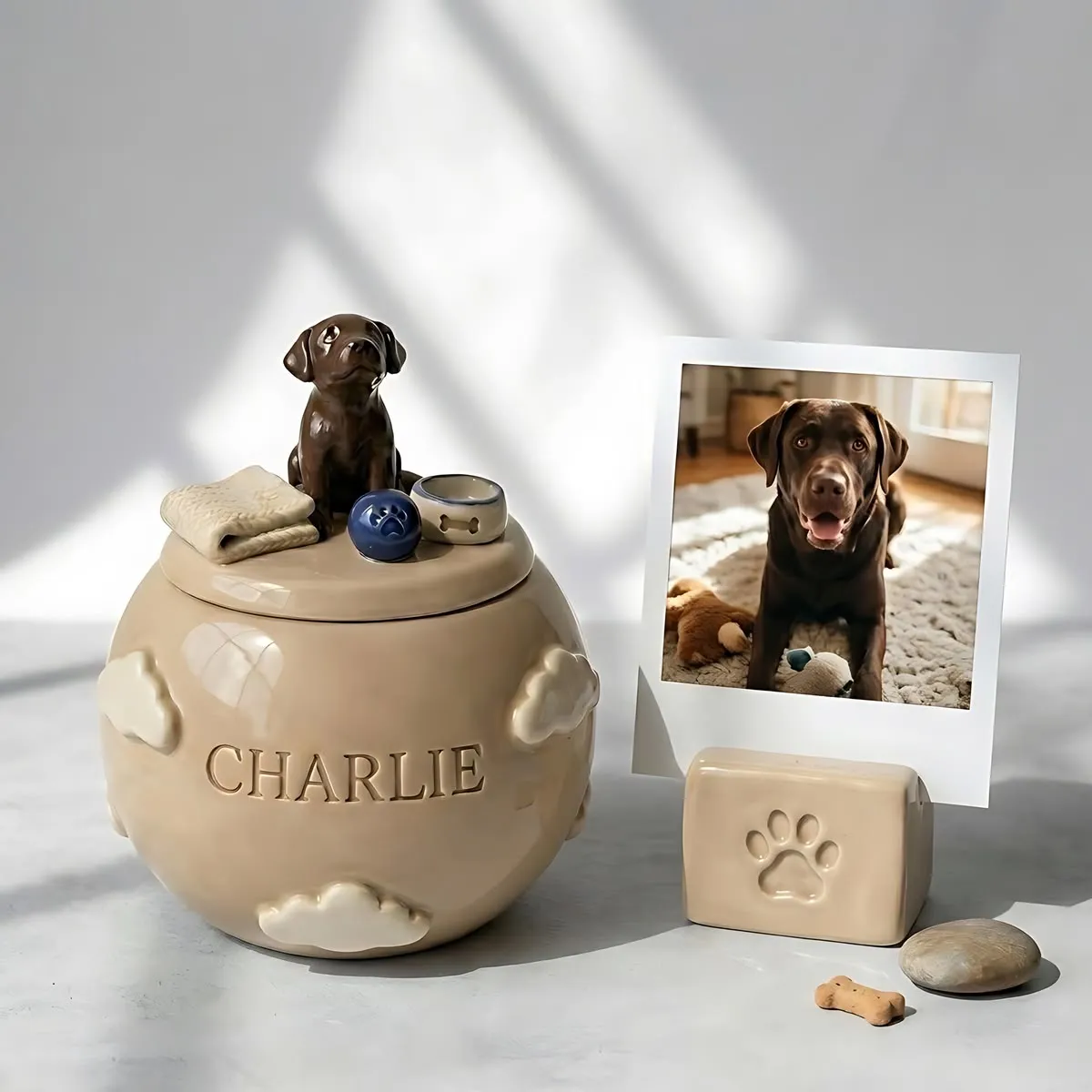
Yes, keeping your pet's ashes at home is perfectly safe, legal, and one of the most common choices pet owners make. Cremation ashes are sterile and pose no health risk. Many families find comfort in keeping their pet close — whether in a decorative urn on the mantel, a keepsake box, or a special memorial display.
The short answer — Keeping pet ashes at home is safe in every state, with no health risk to people, children, or other pets. Most families display the urn on a mantel or shelf, in a quiet corner, or in a memorial display alongside photos and paw prints. There is no time limit on the decision, no rule about what you have to do eventually, and no wrong choice.
Is it safe to keep pet ashes at home?
This is the question we get asked most often, almost always with a small amount of guilt attached, and the answer is: yes — fully, unambiguously, in every state.
Cremated remains are completely sterile. Cremation reaches 1,400–1,800°F, a temperature that destroys all bacteria, viruses, fungi, and any biological matter. What remains is essentially mineral — primarily calcium phosphates and trace minerals — fine, dry, and inert. There's nothing alive in there, nothing decomposing, nothing capable of becoming so.
That means:
- No health risk to people. You can hold the urn, open it, transfer the ashes, and there is nothing to be exposed to. Some families like to keep a small portion in a keepsake; that's safe too.
- No risk to children. A child who accidentally opens a sealed urn or comes into contact with cremated remains is not in any danger. (You may want a sealed urn anyway, for spill reasons, but not for safety reasons.)
- No risk to other pets. Dogs and cats sometimes investigate a new urn with curiosity — they recognize a scent change in the room, not the ashes themselves, which are odorless. There's no risk if a curious nose makes contact.
Common myths worth setting aside: ashes don't smell, don't release dust into the air on their own, don't degrade or "go bad," and don't lose anything if they sit on a shelf for years instead of being scattered. They're as stable as the ceramic urn that holds them.
If you want to keep your pet's ashes at home for a week, a year, the rest of your life, or simply until you decide — that's all valid. The decision doesn't expire.
Choosing the right urn for your home
The right urn is whichever one feels right when you put it on the shelf. That said, there are a few practical decisions to make.
Material
- Wood — warm, traditional, often custom-engraved with a name and dates. Good for a quiet, classic display. Typical price: $40–$150.
- Ceramic — handmade ceramic urns offer the most artistic range and the most "unique to your pet" feel. Many studios match the urn to a pet's coloring or personality. Typical price: $80–$300+.
- Metal — pewter, brass, stainless steel. Modern, durable, often the most secure seal. Typical price: $50–$200.
- Stone or marble — heaviest and most permanent-feeling. Good for a fixed mantel placement. Typical price: $100–$300.
- Glass — increasingly popular for pets. Some studios will incorporate a small portion of the ashes into the glass itself, creating a piece of art rather than a container. Typical price: $150–$500.
- Biodegradable — for families who plan to bury or scatter eventually. Not the right choice if you intend to keep at home long-term, but worth knowing about. Typical price: $25–$80.
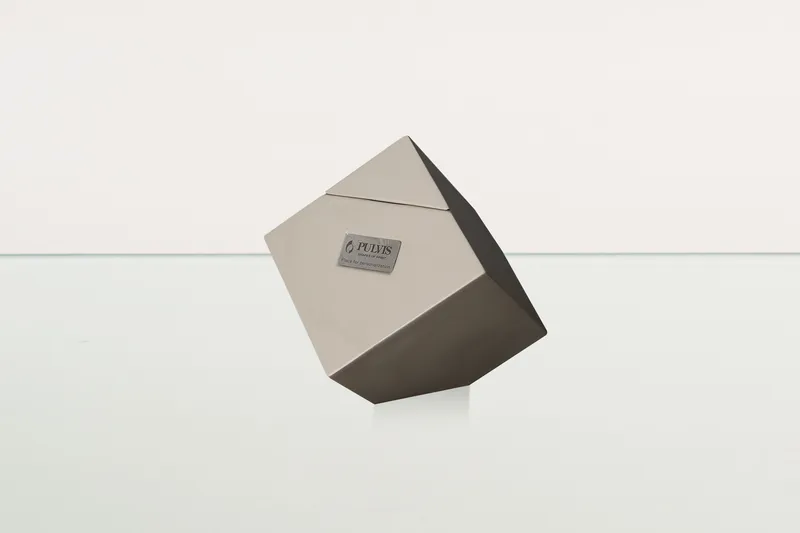
For handmade ceramic options, Pulvis Art Urns offers unique artisan pieces starting at $99 — each one hand-thrown and glazed in their studio. See our full Pulvis Art Urns review for our hands-on impressions, or our best pet urns guide for a broader survey across price ranges, including budget picks (Pet Memory Shop, $30–$80) and premium options.
Size
The standard rule is 1 cubic inch of urn capacity per pound of pet body weight.
| Pet weight | Urn capacity needed |
|---|---|
| Up to 15 lbs (cats, small dogs, rabbits) | 15–25 cubic inches |
| 15–35 lbs (small to medium dogs) | 25–50 cubic inches |
| 35–70 lbs (medium dogs) | 50–80 cubic inches |
| 70–120 lbs (large dogs) | 80–150 cubic inches |
| 120 lbs and up | 150+ cubic inches |
When in doubt, size up. An oversized urn holds the ashes plus a little air space — perfectly fine. An undersized urn doesn't, and you'll find yourself in a difficult moment when you realize the ashes won't fit.
Style
Modern, traditional, artistic, minimalist, religious, secular — all of these are valid, and the only person whose taste matters is you. Some families pick an urn that "looks like" their pet (warm wood for a sandy lab; a glossy ceramic for a sleek black cat). Others pick something that fits the room. Both approaches are right.
If you're going to display the urn permanently, look at it next to the surface where it will live. Bring home a paint chip or a fabric swatch from the room. The right urn is the one that feels at home in the actual space, not just on the website.
Display ideas for pet ashes
The urn doesn't have to be hidden. Most families find that having the urn visible — quietly, gracefully — is a comfort, not a reminder of grief.
On a mantel or shelf. The most common placement. Pair with a framed photo, a candle, and a small object that meant something — a favorite toy, the first collar, a drawing a child made.
Dedicated memorial shelf. A whole shelf set aside for your pet — urn at center, photos at the back, paw print clay tile, a small plant. Many families add a card with their pet's birthdate and adoption date and the date they passed.
Bedroom or private space. For families who want their pet close but not on display, a bedside table or a quiet corner of a private room works well. The urn can be small (a 25-cubic-inch keepsake holds a portion, with the rest stored elsewhere or scattered) or full size.
Outdoor memorial niche. A covered porch, a garden shelf, a sheltered spot near a flowering plant your pet loved. Outdoor placement requires a sealed, weatherproof urn — wood and ceramic should stay indoors; metal, stone, or sealed glass are better outdoors.
Combined with other keepsakes. Many families build a small shadow box that includes the urn alongside the collar, an ID tag, a clipping of fur, and a few photos. This often becomes the most meaningful display because every object has a story attached to it. For a deeper guide on this approach, see creating a meaningful pet memorial at home.
Shadow box display. A glass-fronted shadow box with the urn at center and meaningful objects around it. A favorite for families who want the memorial to feel intentional rather than ad-hoc.
Can you divide pet ashes between family members?
Yes — this is one of the most common follow-up decisions, and it's completely fine.
Cremation typically returns 3–5% of a pet's body weight in ashes. So a 60-pound dog produces roughly 2–3 pounds of ashes — enough to divide several ways without any single portion feeling small.
Common approaches:
- One family member keeps the main urn, and others receive a small keepsake urn (typical capacity 5–15 cubic inches) for their own home.
- Memorial jewelry holds a few teaspoons of ashes in a pendant or ring. Many families have one piece per family member, all from the same pet. See our best cremation jewelry guide.
- A memorial diamond uses a larger portion (typically 100–200 grams of ashes) and produces a single stone — sometimes split into multiple smaller stones for siblings or partners. See our Eterneva memorial diamonds review for how that process works.
- Some kept, some scattered. A portion stays in an urn at home; the rest is scattered somewhere meaningful. There's no rule against this.
A common arrangement we hear from families: one parent keeps the main urn at home, each child wears a small pendant, and a portion is scattered at the dog park where the pet spent every weekend. All three things, all from one pet, all valid.
What if you change your mind later?
Ashes keep indefinitely. There is no rush to decide, and there's no decision you can't undo.
- Want to scatter some later? You can do that any time — see our pet ash scattering guide for how. Most families who scatter eventually do so years after the cremation, when they've had time to think about where.
- Want a memorial diamond made from a portion? Eterneva and similar services accept ashes years after cremation; the chemistry doesn't care about the date.
- Want to transfer to a different urn? Open the bag inside the original urn (sealed plastic, sometimes inside a velvet pouch), carefully transfer to the new urn, reseal. No equipment needed, no time limit.
- Want to bury the ashes eventually? A biodegradable urn for a tree planting, or a sealed urn for a permanent garden memorial — either works at any point.
You don't have to decide now. The most important thing right now is that the ashes are home, in something that feels right, in a place that feels right. Everything else can wait as long as it needs to.
Cultural and personal considerations
Different families approach this in different ways, and there is no wrong choice.
Some cultures and faith traditions favor scattering or burial — returning the body to the earth or the elements. Others favor keeping and displaying — staying close. Most modern American families do some combination, often without thinking of it in cultural terms at all.
If you're getting pressure from family members who feel the ashes "should" be done a certain way, it's worth knowing that there is no widely recognized rule that says any approach is correct. The pet was yours. The decision is yours.
If you're not ready to decide at all — that's also fine. Most families wait weeks or months before they pick a permanent placement. Some never move past the original temporary box the crematory provided, and that's also valid.
The simplest test: when you imagine the urn sitting where you're thinking of putting it, does it feel like comfort or like a knot in your stomach? If it's comfort, that's the right answer. If it's a knot, try somewhere else, try a different urn, or just give it more time.