The Rainbow Bridge Poem: Full Text, True Story, and Printable Version
Read the Rainbow Bridge poem in full. The true story of Edna Clyne-Rekhy, who wrote it in 1959 for her dog Major, plus a printable version and what it means.
If you have just lost a pet, someone has probably already sent you the Rainbow Bridge poem, or you have gone looking for it yourself, the way millions of grieving pet owners have before you. Both the poem and its story are here. And the story, it turns out, is one of the most remarkable in all of pet loss: for sixty-four years, nobody knew who wrote it.
The short answer: The Rainbow Bridge poem describes a meadow just this side of heaven where pets who have died are made young and whole again, and where they wait, joyfully, to reunite with the person they loved and cross the bridge together. It was written in 1959 by Edna Clyne-Rekhy, a nineteen-year-old in Scotland grieving her Labrador, Major, and it circulated unsigned for decades until her authorship was finally confirmed in 2023.
The Rainbow Bridge poem, in full
Here is the poem as Edna Clyne-Rekhy originally wrote it, in the prose form she set down by hand in 1959. Use the copy button to take it with you, or the print button lower on this page for a keepsake version.
The Rainbow Bridge · 1959
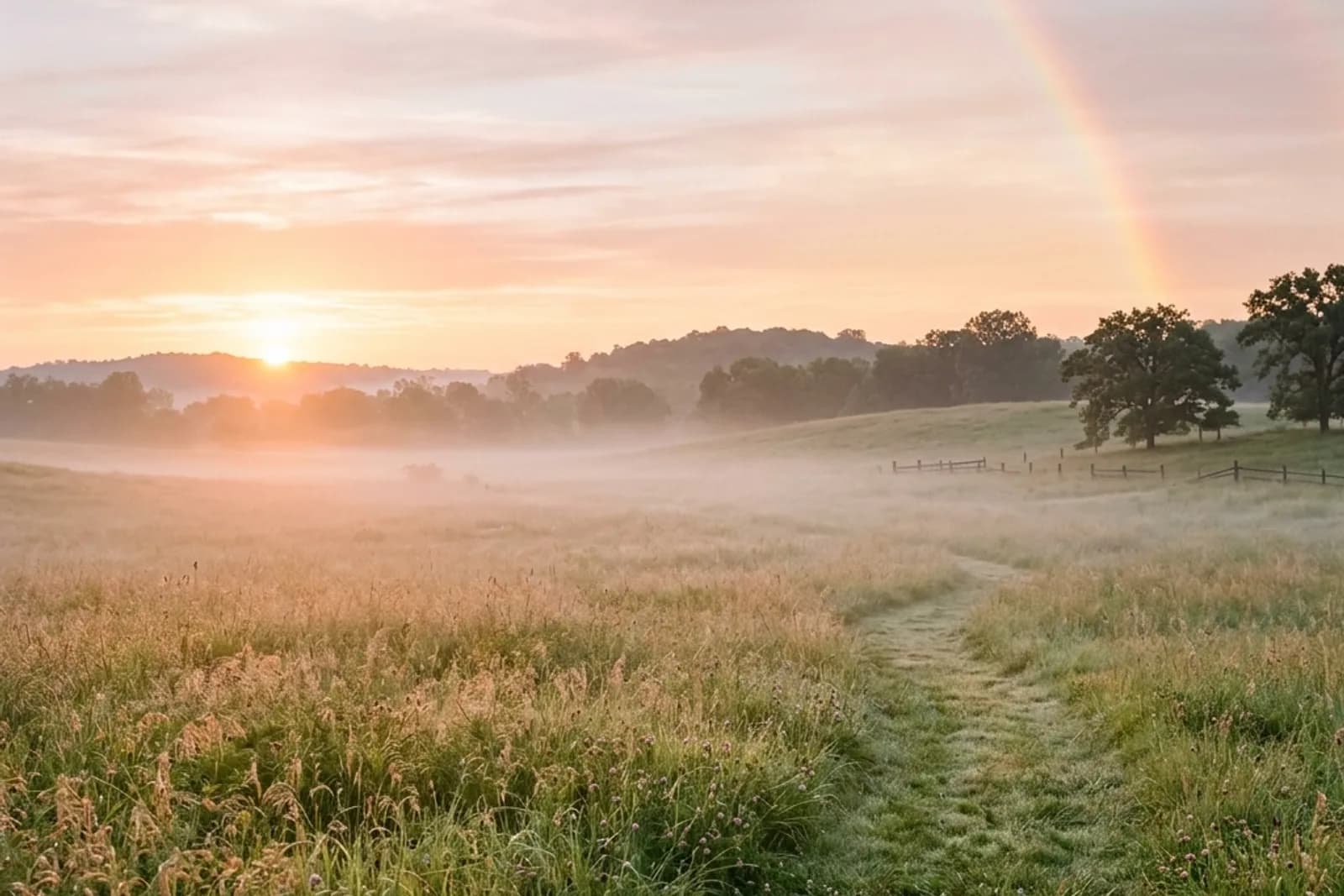
Just this side of heaven is a place called Rainbow Bridge.
When an animal dies that has been especially close to someone here, your pet goes to Rainbow Bridge. There are meadows and hills for all of our special friends so they can run and play together. There is plenty of food, water and sunshine, and friends are warm and comfortable.
All the animals who have been ill and old are restored to health and strength, those who were hurt are made better and strong again, like we remember them before they go to heaven. They are happy and content except for one small thing, they each miss someone very special to them who had to be left behind.
They all run and play together, but the day comes when one suddenly stops and looks into the distance, his bright eyes are shining, his body shakes. Suddenly he begins to run from the herd, rushing over the grass, his legs carrying him faster and faster, and when you and your special friend finally meet, you cuddle in a happy hug never to be apart again.
You and your pet are in tears. Your hands again cuddle his head and you look again into his trusting eyes, so long gone from life, but never absent from your heart, and then you cross the Rainbow Bridge together.
Who wrote the Rainbow Bridge poem?
The Rainbow Bridge poem was written by Edna Clyne-Rekhy, and for most of the poem's life, nobody knew that.
In 1959, Edna was nineteen years old and living in Scotland when her Labrador Retriever, Major, died. He was her first dog, and she would later describe an almost telepathic closeness between them. The day after he died, she felt a compulsion she could not explain: there was something she needed to write. She pulled paper from a notebook, by accident a page her sister had already written on, erased her sister's writing, and filled the page with what became the Rainbow Bridge.
She showed it to her mother and a few close friends, and years later to her husband, Jack. He told her she should publish it. She said no. The words were something private, between herself and Major. Eventually she typed out a handful of copies for friends who had lost pets of their own, and she never put her name on a single one.
That small act of generosity is how one of the most beloved pieces of writing about grief slipped quietly out into the world without its author.
How Edna Clyne-Rekhy was found in 2023
The mystery was finally solved by Paul Koudounaris, an American art historian who had been researching a book on pet cemeteries and became determined to find the poem's true author. His research led him to Edna, by then in her eighties, who was stunned to learn that the private words she had written for Major had comforted millions of people around the world.
The proof was in her attic, in a box labeled "If you can't find it, it's in here." Inside were the original handwritten pages from 1959: one bearing her teenage corrections, crossed out and rewritten, another with her sister's erased schoolwork still faintly visible beneath the words. Her handwritten original even spells "shining" as "shineing," a small teenage misspelling that survives as a kind of watermark of authenticity. When Edna held the pages again and read them aloud, she cried.
National Geographic covered the discovery in February 2023, and told the world what pet lovers had wondered for generations: the Rainbow Bridge had an author all along, a young woman who wrote it out of love for one particular dog. She told them she was absolutely stunned. She had no idea the poem had ever left her circle of friends.
What the Rainbow Bridge poem means
The poem endures because it answers the two hardest parts of pet grief in a single image. The first is the ache of what our pets suffered at the end: in the meadow by the bridge, the old are made young, the sick are made well, and the hurt are made strong. The second is the unbearable thought that the parting is final: at the Rainbow Bridge, it is not. The whole poem leans toward that moment of reunion, the running welcome, and the crossing made together.
It is worth noticing what the poem does not do. It does not tell you to stop being sad, or that your pet was "just an animal," or that grief has a deadline. It assumes, correctly, that this was family. That is why it comforts, and why people who receive it in a card at their lowest moment so often keep it for the rest of their lives. Whatever your beliefs about a pet afterlife, the poem offers a place to put the love that suddenly has nowhere to go. If the grief itself feels overwhelming, our guide to coping with pet loss can help with the heavier days, and it is normal to need it.
A printable Rainbow Bridge poem
There is a reason so many people search for a printable version of this poem. On paper, it becomes something you can hold: framed beside an urn, tucked into a sympathy card, read aloud at a small backyard goodbye, or kept folded in a wallet. Use the button below to print this page's clean, poem-only version, on cardstock if you have it, and it will sit beautifully in a standard frame.
If you are gathering words for an engraving or a card as well, our collection of pet loss quotes pairs well with the poem, and our guide to creating a memorial walks through urns, stones, gardens, and keepsakes.
The love is the bridge
Edna Clyne-Rekhy wrote these words for one dog, out of one particular love, and they turned out to fit every dog, every cat, and every person who has ever whispered goodbye to an animal. That is the quiet truth inside the poem's long, anonymous journey: the author hardly mattered to the millions it comforted, because the love in it was recognizably their own.
However you imagine what comes next, a meadow, a bridge, or simply a memory that refuses to fade, the bond you shared is not undone by death. Keep the poem close if it helps. Say their name. And when you are ready, give them a place to be remembered, whether that is a frame on the wall or a memorial you create in their honor.
They are, as the poem promises, never absent from your heart.
The First Month
Practical help for the days after your pet dies.
Questions to ask a crematory. Words for telling children. Pages for decisions about ashes and belongings.
26 one-page cards, printable checklists, and fillable worksheets. Choose the situation you need help with and start there.
Inside the PDF. Tap a page to read it.
One payment. Instant PDF download. No subscription. Yours to print and keep.
You'll see Affluenss at checkout. FindPetCremations is operated by Affluenss LLC.
If it isn't what you needed, reply to your delivery email for a refund. No questions.
Card 1 of 26, free
The first night
The rule: nothing has to be decided tonight, except one thing.
Read tonight's cardClose the card
If they are still at home with you
The one thing to decide tonight is where they rest until morning. That is all.
- Lay them on a towel or a blanket in the coolest room you have: a laundry room, a garage, a tiled floor. Not the car.
- If you can, settle them on their side with the legs gently tucked, the way they slept. Do this soon rather than later. Within a few hours the body stiffens, and it becomes harder to move them with care.
- A little fluid can release. One towel underneath and one folded over is enough. This is normal, and it is not a sign that anything was done wrong.
- In a cool room they can stay overnight and through tomorrow. If it is warm where you are, wrap them in the blanket and then a large bag, and use the coolest space you have.
- Collar on or collar off. Either is fine. Many people take it off tonight and are glad later that they did.
If they died at the vet's
Then the where is already handled, and there is nothing you have to do tonight. The clinic will keep them safely until you have chosen what happens next. You can call in the morning. Card 4 covers what you can still ask the clinic for: time with them, a paw print, the collar back.
What you do not have to do tonight
- Choose a crematory. Tomorrow is fine. Almost every crematory collects within a day, and the person who answers the phone has heard every version of this call. Card 3 has the eight questions to ask.
- Decide private or communal. Card 2, when you are ready.
- Tell everyone. Tell the people in the house. Everyone else can wait until tomorrow, or next week.
- Move anything. The bowl, the bed, the leash by the door: leave them exactly where they are. Card 7 is for when you want it, and there is no deadline.
What to say in the house tonight
To a child: "[Name] died today. Her body stopped working and the vet could not fix it. It was not anyone's fault. We are going to be sad for a while, and that is okay." Then stop talking and let them ask. Card 6 has more, by age.
To each other: nothing clever. "I am so sad" is a complete sentence.
One small thing, if you want one
Sit with them for a few minutes. Tell them one thing you will miss. Turn off the light.
That is a goodbye, and it counts. A fuller one can come later, and card 16 will help. Tonight, this is enough.
If tonight feels like more than you can carry, card 25 has people who answer the phone at this hour.
Frequently asked questions
On this page▾
When you're ready, you can make them a place to be remembered.
Still Here is a free, beautiful online memorial. Light a candle, write their story, and share it with everyone who loved them. No cost, no account, yours to keep.
Create a free memorial →You might also find helpful