Losing a pet is real grief, and the smallest, most ordinary details are the first to blur.
A pet memorial journal is a dedicated place to remember a pet who has died, part diary, part scrapbook, part letter. To make one, choose a notebook, phone note, or made-for-purpose journal, gather a few photos and mementos, and write one specific memory. Add to it whenever you are ready.
This guide covers what a pet memorial journal is, whether writing actually helps, what to put in it, how to start, what kind to use, and prompts for different kinds of loss. It is useful whether you buy anything or use a spare notebook you already own.
The First Month
Practical help for the days after your pet dies.
Questions to ask a crematory. Words for telling children. Pages for decisions about ashes and belongings.
26 one-page cards, printable checklists, and fillable worksheets. Choose the situation you need help with and start there.
Inside the PDF. Tap a page to read it.
One payment. Instant PDF download. No subscription. Yours to print and keep.
You'll see Affluenss at checkout. FindPetCremations is operated by Affluenss LLC.
If it isn't what you needed, reply to your delivery email for a refund. No questions.
Card 1 of 26, free
The first night
The rule: nothing has to be decided tonight, except one thing.
Read tonight's cardClose the card
If they are still at home with you
The one thing to decide tonight is where they rest until morning. That is all.
- Lay them on a towel or a blanket in the coolest room you have: a laundry room, a garage, a tiled floor. Not the car.
- If you can, settle them on their side with the legs gently tucked, the way they slept. Do this soon rather than later. Within a few hours the body stiffens, and it becomes harder to move them with care.
- A little fluid can release. One towel underneath and one folded over is enough. This is normal, and it is not a sign that anything was done wrong.
- In a cool room they can stay overnight and through tomorrow. If it is warm where you are, wrap them in the blanket and then a large bag, and use the coolest space you have.
- Collar on or collar off. Either is fine. Many people take it off tonight and are glad later that they did.
If they died at the vet's
Then the where is already handled, and there is nothing you have to do tonight. The clinic will keep them safely until you have chosen what happens next. You can call in the morning. Card 4 covers what you can still ask the clinic for: time with them, a paw print, the collar back.
What you do not have to do tonight
- Choose a crematory. Tomorrow is fine. Almost every crematory collects within a day, and the person who answers the phone has heard every version of this call. Card 3 has the eight questions to ask.
- Decide private or communal. Card 2, when you are ready.
- Tell everyone. Tell the people in the house. Everyone else can wait until tomorrow, or next week.
- Move anything. The bowl, the bed, the leash by the door: leave them exactly where they are. Card 7 is for when you want it, and there is no deadline.
What to say in the house tonight
To a child: "[Name] died today. Her body stopped working and the vet could not fix it. It was not anyone's fault. We are going to be sad for a while, and that is okay." Then stop talking and let them ask. Card 6 has more, by age.
To each other: nothing clever. "I am so sad" is a complete sentence.
One small thing, if you want one
Sit with them for a few minutes. Tell them one thing you will miss. Turn off the light.
That is a goodbye, and it counts. A fuller one can come later, and card 16 will help. Tonight, this is enough.
If tonight feels like more than you can carry, card 25 has people who answer the phone at this hour.
What is a pet memorial journal?
A pet memorial journal, also called a pet loss journal or pet grief journal, is a dedicated place to remember a companion who has died. It can hold diary entries, scrapbook pages, and letters, all in one place. A memory book leans more on photos and keepsakes, while a journal leans on writing, but many people blend the two.
There is no correct format. Some people fill a page a night for a week and then set it aside. Others add to it for years, on birthdays, hard anniversaries, and ordinary Tuesdays. It can hold written entries, a dedication page, photo captions with dates, and small mementos tucked in pockets: a collar, tags, a clay paw print, a lock of fur. If you are in the first raw days and not sure where anything goes yet, our guide on what to do when your pet dies walks through the practical steps too.
Does journaling actually help with pet grief?
For many people, yes. Putting hard feelings into words can be a relief, and a journal gives pet grief somewhere to go. Pet loss is often disenfranchised, meaning the world may not treat it as a real loss, so a private page lets your grief be taken seriously on your own timeline.
Grief specialists also describe healthy mourning not as letting go but as finding new ways to carry an ongoing bond, sometimes called continuing bonds. Saying your pet's name, keeping their collar, or writing to them can be part of that. A journal makes room for feelings that are hard to say out loud, including guilt, which many people find hard to speak about. If you are replaying the last days and second-guessing yourself, you are not alone, and our piece on pet loss guilt may help you set some of it down.
None of this is a cure or a finish line. Grief has no fixed timeline and rarely moves in neat steps. A journal simply gives you a place to put the love while you carry it. If you want more on the shape grief takes, see our guide to coping with pet loss.
What do you write in a pet memorial journal?
Start with concrete details before they fade: your pet's name and nicknames, the sounds they made, the spots they claimed, and one ordinary day from start to finish. Later you can add funny stories, favorite photos with dates, the hard parts, and a letter written straight to them. There is no wrong order.
If a blank page feels impossible, begin with one specific thing only you noticed. You are not writing an obituary or a eulogy, though you can. You are catching details before they blur. Skip any prompt that is not yours.
Who they were
- Their name, and every nickname it turned into.
- The sound of them: the bark or meow, nails on the floor, the sigh when they finally settled.
- The spots they claimed: the warm patch of sun, the corner of the couch, their side of the bed.
- The look that meant food, or walk, or you are home.
The ordinary days
- A normal morning with them, start to finish.
- The thing they did that always made you laugh.
- A favorite photo, its date, and the story behind it.
- The routines you shared without thinking, the ones you miss most now.
The bond and what they taught you
- A time they comforted you without being asked.
- What they seemed to understand about you.
- How they changed you, and who you became with them.
The hard and honest parts, when you are ready
- How you knew, or how they let you know.
- What the last day was like, if and when you can write it.
- Any guilt, anger, relief, or regret you carry. Name it plainly. This page is only yours.
A letter to your pet
Write to them directly. Tell them what you did not get to say, what has changed since they left, and what you carry forward because of them. Many people find this the hardest prompt to begin and the one they return to most. You do not have to fill every prompt, and a single true sentence is enough for one night.
How do you start a pet memorial journal?
Start small and let it be imperfect. Choose something to write in, gather a few photos and mementos, add a dedication line, then write one specific memory before it blurs. Use a prompt when you feel stuck, add the harder feelings when you are ready, and come back to it over time. Here is a simple order.
- Choose something to keep it in: a plain notebook, a note on your phone, or a journal made for the purpose.
- Gather your photos and mementos: the collar, tags, a clay paw print, a favorite photo, a lock of fur.
- Write a dedication or opening line: your pet's name, their dates, and one sentence about who they were.
- Start with one specific, ordinary detail: a sound, a habit, a spot they claimed as theirs.
- Use a prompt when you feel stuck: the day you met, your favorite memory, what they taught you.
- Add the harder feelings when you are ready: guilt, relief, the last day, a letter to them.
- Come back to it over time: on birthdays, anniversaries, or any day you miss them.
What kind of pet memorial journal should you use?
The container matters less than the writing. A plain notebook is free and immediate, a phone note is easy to add to at any hour, and a made-for-purpose journal gives you prompts and a keepsake to hold. Any of them works honestly. Here is how the three compare.
| Option | Cost | Best for | Watch out for |
|---|---|---|---|
| A plain notebook | Free, or a couple of dollars | Writing right now, in your own words, no prompts | Loose notebooks get misplaced over the years, so keep it somewhere safe |
| A phone or digital note | Free | Adding memories at 2 a.m., photos, backups, and searching later | It can feel less like a keepsake, and it is easy to forget in a full phone |
| A made-for-purpose journal | Paid | Gentle prompts when you are too tired to think, and a physical object to keep | Costs more than a notebook, so choose one you will actually reach for |
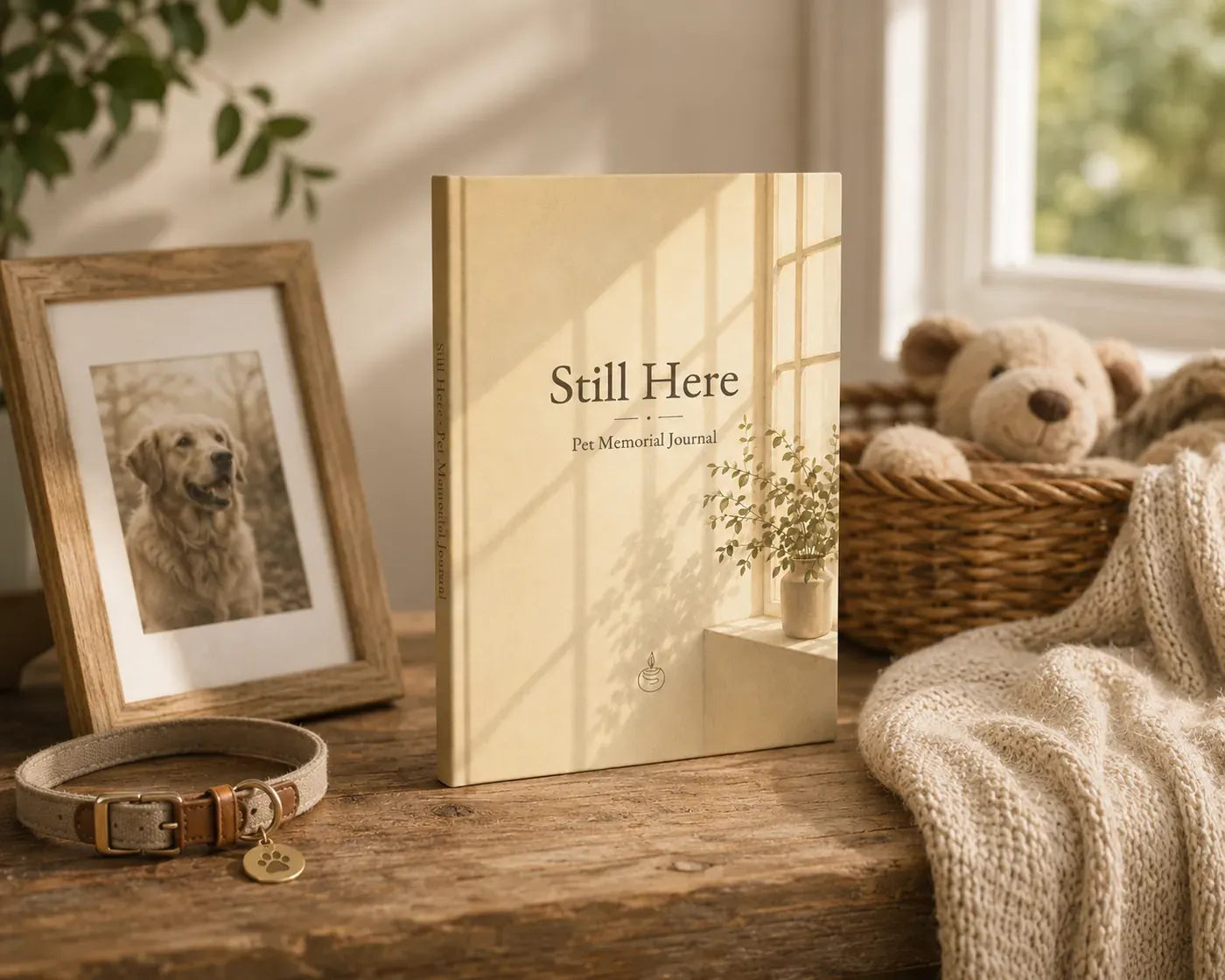
If that last option is the one you want, it is the one we make. Still Here: A Pet Memorial Journal is our printed journal: a linen hardcover with gentle prompts like the ones above, 120 pages, printed to order, $99 with US shipping. It is designed to sit somewhere you will see it, not disappear into a drawer.

Still Here is our own pet memorial journal, made by the FindPetCremations team. You can see the Still Here memorial journal if a made-for-purpose pet loss keepsake feels right. If it does not, a notebook you already own will do the job just as faithfully. The writing is what matters, not the cover.
What are some prompt ideas for different situations?
Different losses call for different words. For a dog, write about walks and greetings at the door. For a cat, the spots they chose and the trust they gave. After a sudden death, capture what you remember before shock blurs it. After euthanasia, make room for relief and guilt side by side.
For a dog
Write about the day you brought them home or their puppy weeks, the walk you took most, and how they greeted you at the door every single time. Note the breed quirks, the toys they guarded, and the exact sound of their tags in the hall.
For a cat
Write about where they chose to sleep, the trust it took for them to settle on your chest, and the small daily negotiations that were entirely theirs. A cat can withdraw or change routine after a loss, in quiet ways that are easy to miss, so record the particular ways they were present.
After a sudden or unexpected loss
When there was no goodbye, shock and numbness are normal. Write down everything you can remember before it fades, even out of order: the last ordinary moment, what they were doing, the last time you touched them. You are not required to make it a tidy story.
After euthanasia
Relief and guilt can sit together, and both belong on the page. Write through the decision, the question of whether it was the right time, and what you would tell them about it. This is exactly the kind of honest, ambivalent grief a private journal is built to hold.
How do you carry them forward after the last page?
You do not have to finish a memorial journal, and you do not have to stop. Some people fill it in a week, others add to it for years on birthdays and quiet days. When you are ready, you can turn a favorite entry into a tribute or share their story in a free online memorial.
However you keep it, a journal is one gentle way to memorialize a pet: a way of saying this life mattered, and I am not letting the details go. A favorite entry can become a short pet obituary or tribute, and the mementos you gathered can join other pet memorial ideas and keepsakes around your home.
When you are ready, you can also make them a free online memorial at Still Here. It lets you light a candle, add their photo, and share their story with everyone who loved them, and there is no time limit on it. Some families keep both: the printed journal for the private words, the free online memorial for the shared ones.
They were here. With a little writing, they stay close.